Episode 139:
She Got Into Her Teacher’s Car, Then Next Day His Wife Caught Him Scrubbing the Seat

On January 13, 2004, Busan police received a call from a young woman: her sister's phone had been off for a week. The missing woman was 21-year-old Jungmi Choi, a college student who'd lost both parents to divorce and her grandmother to illness, leaving her with only her sister in the world. But in 2004, South Korea's laws for investigating missing adults were so weak that police simply assumed she'd run off on her own, and no real search began.
A month later, on February 8, 2004, a report came in to police in Ulsan, an hour from Busan: something was lying on a steep, abandoned slope near Mount Gaji. Officers found a woman's body, dead for at least a month, her hands, feet, and neck all bound tightly with rope. The freezing winter cold had preserved almost nothing usable — investigators had to thaw the body with a hairdryer before they could even begin the autopsy, which ultimately ruled the cause of death as strangulation. With fingerprints destroyed by the freeze-thaw cycle, police could only identify her through a distinctive star-shaped necklace, which eventually matched her to the missing person's report. It was Jungmi.
The Teacher Who Had Been Grooming Her Since She Was 18
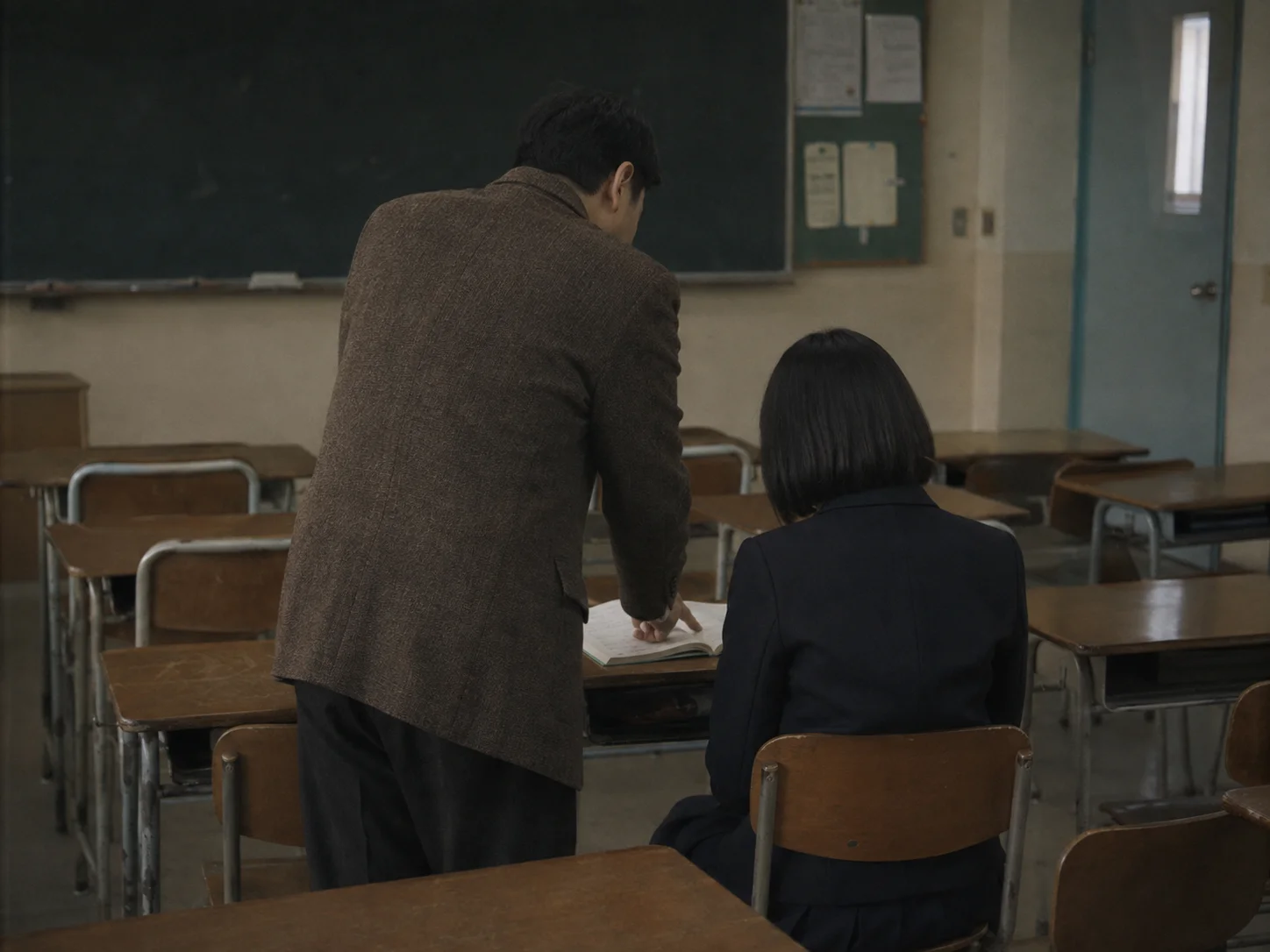
Police traced Jungmi's last known contacts and found she'd been in constant touch with a 40-year-old man named Moonho Kim — texting and calling daily, including right up until 6 p.m. on the day she vanished, before all contact abruptly stopped. Kim turned out to be an ethics teacher at Jungmi's former high school, and a married father. When investigators searched Jungmi's home, they found photos of the two of them posed like a couple, not a teacher and former student, along with three years of emails dating back to 2001 — when Jungmi was still only 18. What began as after-school tutoring had turned into a secret relationship that isolated Jungmi from her peers, a textbook pattern of grooming. At the time, though, it wasn't a crime: Korea's statutory rape law only covered victims under 13, so nothing about the relationship was technically illegal until grooming itself was finally criminalized seventeen years later, in 2021.
The Wife Who Cracked the Case

Confronted by police, Kim denied any affair and gave three different, uncorroborated alibis for the night Jungmi disappeared. Phone records showed his location ping from a payphone near Jungmi's home at 7 p.m. that evening, then his own phone went dark until it reappeared near Mount Gaji at 6 a.m. the next morning — directly matching the location where Jungmi's body was found. Still, Kim held his ground until his wife walked into the police station herself, telling them she'd known about the affair all along, that he hadn't come home the night Jungmi vanished, and that the next morning she'd caught him washing the passenger seat cover, something he'd never once done in their marriage. Acting on her tip, police sprayed his car with Luminol and found blood — not on the passenger seat as she'd described, but soaked into the floor of the back seat, exactly where a body would have been hidden during the drive to Mount Gaji.
The Murder in His Car

Once Jungmi started college, she'd tried to leave the relationship behind and date someone her own age — and investigators believe that was exactly what Kim couldn't accept. On the night of January 6, he called her from a payphone, begged to see her one last time, and lingered outside her house for hours before they finally sat down together in his car. Their conversation was interrupted when Jungmi's new boyfriend called; she reportedly took the call right in front of Kim, and by the time she hung up, the two were locked in a violent argument. Kim punched her unconscious, then strangled her with rope he had in the car, believing exposure of the affair would destroy his career and family. He drove her body to the same secluded road in Mount Gaji where they used to meet secretly, threw her down the slope, and texted his wife an apology before heading home.
Final Thoughts
In July 2004, Moonho Kim was convicted of murder and abandoning a body and sentenced to life in prison. The court specifically condemned the fact that he was an ethics teacher who had murdered his own student. What makes this case so devastating isn't just the murder itself, but the years of grooming that preceded it — manipulation that wasn't even recognized as a crime under Korean law until 2021, meaning countless other victims of the same tactics went unprotected for nearly two decades. Jungmi had already lost every adult who was supposed to protect her; the one man who stepped in when she needed someone most turned out to be the person who would eventually take her life.
Because Korea's statutory rape age was under 13 at the time, what Moonho Kim did to Jungmi starting when she was 18 wasn't legally a crime until grooming itself was finally criminalized in 2021 — seventeen years after her murder. How many other victims do you think went unrecognized during those seventeen years simply because the law hadn't caught up yet?
WE DOCUMENT.
YOU DECIDE.
Our interpretation is only one possible perspective.

